McDonald’s has more marketing money than most countries have budgets. Last Christmas, McDonald’s Netherlands used some of it on an AI-generated holiday ad. The internet called it soulless, the comments got so bad they were switched off, and the ad was pulled within days. Coca-Cola has now shipped two AI Christmas ads in two years and been roasted for both. Viewers spotted the truck wheels changing shape between frames and described the animals as part shiny, part plastic.
These are companies that can afford anything. They chose AI to save money on the one thing their customers actually see. And their customers noticed, immediately, and made them pay for it.
If the giants can’t get away with it, what do you think happens to a small business that tries?
Distrust doubled in twelve months
This isn’t a vibe. It’s been measured, twice, a year apart, with the same questions.
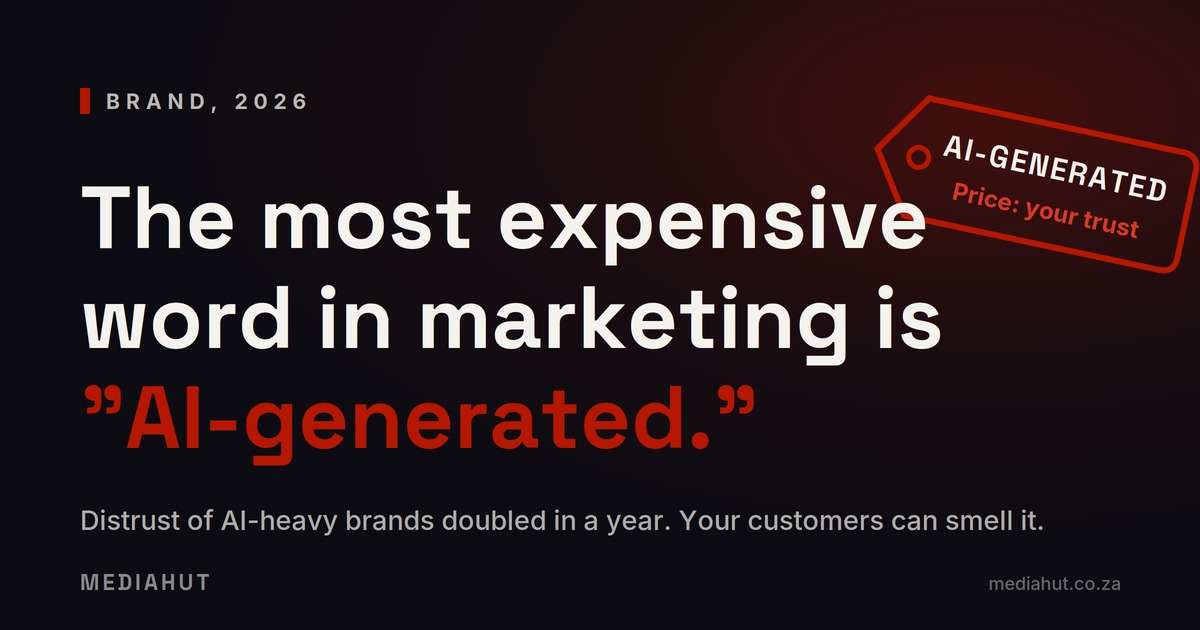
In 2025, one in five consumers said heavy AI use would make them trust a favourite brand less. In 2026, it’s two in five. Doubled, in a year. Meanwhile just 14% say heavy AI use would make them trust a brand more. Younger customers punish hardest: over half of Gen Z says a favourite brand leaning on AI for its marketing would lose their trust.
Read that again slowly. Two years ago, slapping “AI-powered” on your business made you look innovative. Today it’s a liability with a paper trail. The word your marketing agency keeps pitching as the future is quietly costing you the thing you can least afford to lose.
People can smell it now
Here’s the uncomfortable part. Your customers have developed a nose for machine-made content, and the nose is getting sharper every month.
They notice the copy that hits every expected beat without saying anything. The blog post with the same rhythm as ten thousand other blog posts. The suspiciously perfect product photo with six fingers hiding in the background. Earlier this year someone spotted a single line of AI-sounding copy on a Nike product page and it became a public conversation about whether Nike had lost its voice. One line. On a product page.
And the brutal bit: it’s not really about quality. Researchers ran an experiment where they showed people the identical ad, telling half it was a photo and half it was AI-generated. Same pixels. The AI-labelled version was rated less natural, less credible, and fewer people wanted to buy. The label alone did the damage.
Because the label tells your customer something about you. It says: this business couldn’t be bothered to make something real for me. Nobody says it in those words. They just don’t phone.
The big brands are running your experiment for free
Watch what the smart money is doing right now. Dove publicly pledged never to replace people with AI in its advertising. This year Aerie, Equinox and Almond Breeze all ran campaigns openly mocking AI slop. These are billion-rand marketing departments, and they’ve read the same research you just did. They’re repositioning “made by humans” as the premium.
Think about what that means. Companies with infinite budgets are spending fortunes trying to look human.
You already are.
This is the best news a small business has had in years
A small South African business can’t outspend Woolworths and can’t out-logistics Amazon or Temu. Your entire competitive advantage is that you’re a person. Your face on the About page. Your workshop, your kitchen, your actual hands doing the actual work. The voice note you send a client at 7pm because you had an idea about their project.
That’s the one asset the giants are now desperately trying to counterfeit, and you get it for free. So the strategy writes itself: don’t automate away the only thing they can’t buy.
This does not mean AI is useless. Use it for the plumbing. Drafts, admin, data, research, the invisible grunt work; that’s where it earns its keep, and your customers will never know or care. Where it kills you is anything with your name on it. Your website copy, your photos, your videos, the message a customer receives when they ask a question. The moment the customer-facing layer of your business reads like it was generated, you’ve traded your only advantage for a saving that fits in a lunch tin.
The test
Pull up your own website and read it out loud. If it sounds like something no human being would ever say to another human being across a counter, it’s costing you money, whether a machine wrote it or not. AI didn’t invent hollow marketing. It just industrialised it, and taught your customers to flinch at it.
The businesses that win the next few years won’t be the ones using the most AI or the least. They’ll be the ones whose customers never have to wonder if anyone’s home.
If your brand has started sounding like everyone else’s, we should talk. Humans answer.