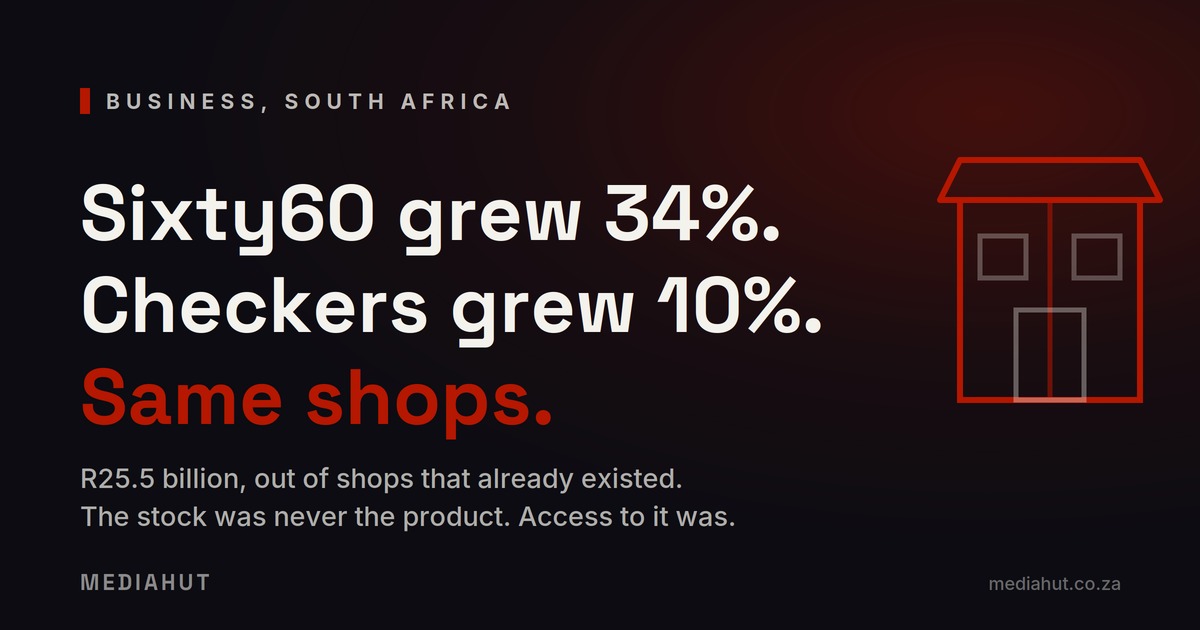
Shoprite released its operational update a fortnight ago and the market lost its head, sending the shares up more than 8% in a day. The number that did it was Checkers Sixty60, which turned over R25.5 billion in the year to June, growing 34.5%. The Checkers stores it delivers from grew 10% over the same period. The group as a whole managed 7.2%.
Roughly a third of the entire group’s growth came from an app. Put that another way. Shoprite Holdings added R18.1 billion in new sales last year, and R6.6 billion of it arrived through a phone.
Now here’s the part worth stealing, and it has nothing to do with having a development budget.
They didn’t build a delivery company
Everyone reads a story like this and concludes that the winners are the ones who built something new. That isn’t what happened.
Sixty60 delivers out of Checkers stores that were already trading. Buildings the group already owned, in suburbs where its customers already lived, stocked with products already sitting on shelves, staffed by people already clocked in. The app didn’t create any of that. It just stopped treating those shops as shops and started treating them as fulfilment centres.
That’s the whole trick. A Checkers in Sandton didn’t become a warehouse. It always was one. Nobody had bothered to sell it that way.
And note what the customer is actually buying, because it isn’t cheaper groceries. The prices are the same as in the shop, and they pay a delivery fee on top. What they’re paying for is an hour of their Saturday. The stock was never the product. Access to it was.
Every competitor trying to catch up has to build the network first. Checkers had it before the app existed.
Nobody knows if it makes money yet
Being straight about this matters, because the internet is currently full of people treating R25.5 billion as proof of genius.
Shoprite Holdings does not disclose Sixty60’s profit. The turnover sits inside the Supermarkets RSA line, delivery cost accounting was recently changed, and full results only land on 1 September. Grocery delivery has bankrupted better-funded companies than this one, all over the world, for the simple reason that the last mile is brutally expensive.
So the lesson isn’t that delivery is a licence to print money. It’s narrower and more useful than that: the growth came from selling easier access to something the business already had.
What’s already on yours
This is where it gets uncomfortably relevant, because most small businesses own something similar and don’t sell it.
Your location is same-day delivery to everyone within ten kilometres, if anyone knew it existed. Your quiet Tuesday mornings are capacity you’re already paying rent on. The knowledge you give away free on every phone call is a paid product for the people who can’t afford your full service. The customer list sitting in your accounting software is a channel you’ve never used. The workshop, the kitchen, the studio, the van, the storeroom, the twenty years of knowing which supplier actually delivers on time.
None of that requires investment. It requires noticing, and then telling people it exists.
The cheap version of the same move
A restaurant with a kitchen that’s dead between two and five is not a restaurant with a problem. It’s a prep kitchen for a lunch delivery service to the office park down the road, using staff who are already clocked in.
An electrician who has explained the same compliance certificate question four hundred times has a page on his website that brings in work while he sleeps, instead of a conversation he repeats for free.
A shop with regulars whose numbers are all in a WhatsApp group has a sales channel that costs nothing and outperforms the ads it’s currently paying for.
A supplier who knows their stock levels in real time has a website that shows them, which is the entire reason customers phone before driving over.
Every one of those is a small piece of digital work applied to something that already exists. That’s a very different proposition to inventing a business.
Where the work actually is
The technology in all of this is trivial. The hard part is honesty about what you own and what people would pay for.
So do the boring audit. List what your business has that isn’t currently earning: hours, space, stock, knowledge, relationships, reputation, position on a map. Then for each one, ask what would have to be true for someone to pay for it. Usually the answer is that they’d need to know it exists, be able to find it in thirty seconds, and be able to buy it without phoning anyone.
That’s a website problem. It’s almost always a website problem.
Checkers’ advantage was that it looked at buildings it already owned and saw something other than shops. The question isn’t whether you can afford an app. It’s whether you’ve looked properly at what you already own.
If you’re sitting on something you’ve never sold properly, we should talk.